On this page10 sections
First, Do Not Mix Up Filing Year and Year of Assessment
This is the part that causes the most confusion.
When Malaysians file individual income tax in 2026, they are generally filing the return for Year of Assessment 2025. The relevant rate table for a normal 2026 e-Filing exercise is therefore the HASiL YA 2025 schedule.
That is why a page called Income Tax Rate Malaysia 2026 should not quietly swap in future Budget 2027 rates. The current filing and the next announced tax framework are two different things.
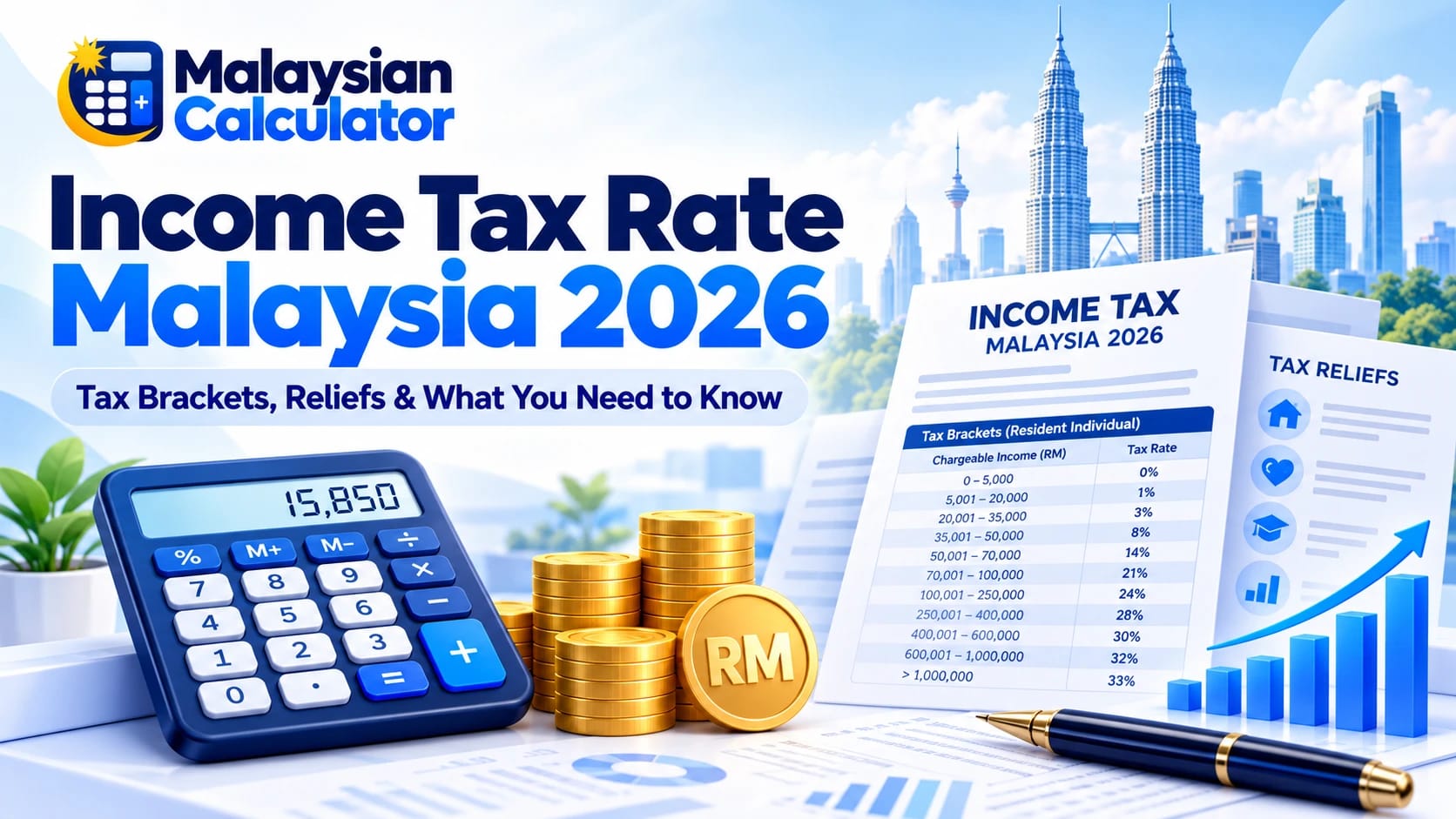
Malaysia Resident Individual Tax Rates for YA 2025
Malaysia uses progressive tax rates for resident individuals. Your entire chargeable income is not taxed at the highest rate you reach.
Instead, each band is taxed at its own rate. If your chargeable income is RM80,000, for example, only the portion above RM70,000 is taxed at 19%. The lower bands are still taxed at their lower rates.
| Chargeable income band | Rate on that band |
|---|---|
| First RM5,000 | 0% |
| RM5,001–RM20,000 | 1% |
| RM20,001–RM35,000 | 3% |
| RM35,001–RM50,000 | 6% |
| RM50,001–RM70,000 | 11% |
| RM70,001–RM100,000 | 19% |
| RM100,001–RM400,000 | 25% |
| RM400,001–RM600,000 | 26% |
| RM600,001–RM2,000,000 | 28% |
| Above RM2,000,000 | 30% |
Example: Chargeable Income of RM80,000
At RM80,000 of chargeable income, the tax is built up band by band.
Tax on the first RM70,000 is RM3,700 under the YA 2025 table. The next RM10,000 falls in the 19% band, adding RM1,900.
That gives estimated tax before rebates of RM5,600.
This is also why two people with the same gross salary may pay different tax. Chargeable income is calculated after the relevant deductions and reliefs, and personal circumstances matter.
Selected Tax Reliefs for YA 2025
Tax reliefs reduce the amount of income that becomes chargeable income. They do not normally reduce final tax ringgit-for-ringgit.
Some widely relevant YA 2025 reliefs include RM9,000 for the individual and dependent relatives, up to RM2,500 for qualifying lifestyle expenses, up to RM7,000 for life insurance and EPF under the applicable sub-limits, up to RM350 for SOCSO contributions, and up to RM8,000 for qualifying net SSPN savings.
HASiL also lists reliefs for medical expenses, education, children, insurance and other qualifying categories. First-home buyers with an eligible Sale and Purchase Agreement from 1 January 2025 to 31 December 2027 may also qualify for housing-loan interest relief: up to RM7,000 for a residential property priced up to RM500,000, or RM5,000 for a property above RM500,000 and up to RM750,000, subject to the conditions.
Claim only reliefs you actually qualify for and keep the required supporting documents.
Resident vs Non-Resident Tax
Tax residence matters.
HASiL states that resident individuals use progressive rates and may qualify for personal reliefs. Non-resident individuals are generally taxed at a flat 30% and are not entitled to the same personal reliefs.
Residence status is a tax-law question, not simply your nationality. If you spent part of the year in and out of Malaysia, check the residence rules before using a normal resident calculator.
What About PCB / Monthly Tax Deduction?
PCB, also called Monthly Tax Deduction (MTD), is tax deducted during the year through payroll.
It is not automatically your final annual tax. When you file your return, the tax already deducted is taken into account against the final amount payable. Depending on your final reliefs, income and PCB already paid, you may have additional tax to pay or a refund due.
Use the PCB Calculator Malaysia for payroll planning and the Income Tax Calculator Malaysia for a fuller annual estimate.
2026 e-Filing Dates to Remember
HASiL opened 2026 e-Filing for YA 2025 from 1 March 2026.
For a resident individual who does not carry on business, the statutory filing date is 30 April 2026. HASiL's 2026 filing programme provides a 15-day grace period for e-Filing.
For a resident individual who carries on business, the statutory due date is 30 June 2026, also with the stated e-Filing grace period in the programme.
If you are reading this after those dates, use MyTax or contact HASiL for the appropriate late-filing steps rather than relying on an old calendar.
The Practical Way to Estimate Your Tax
Start with annual taxable income, subtract only the reliefs that genuinely apply, then calculate tax progressively by band. After that, apply any eligible rebates and credit PCB already deducted.
If you want to test different income and relief scenarios quickly, use the Income Tax Calculator Malaysia. It applies the YA 2025 resident rates used for returns filed in 2026.
Frequently Asked Questions
What income tax rates apply when I file in Malaysia in 2026?
For the normal 2026 individual e-Filing exercise, the return is generally for YA 2025. Resident rates run progressively from 0% to 30% under the YA 2025 schedule.
Is my whole income taxed at my highest tax rate?
No. Malaysia uses progressive bands for resident individuals, so only the portion of chargeable income inside each band is taxed at that band's rate.
What is chargeable income?
It is broadly the amount left after applying the relevant tax rules, deductions and eligible reliefs to taxable income. It is not the same as gross salary.
What is the non-resident personal income tax rate?
HASiL states that non-resident individuals are generally taxed at a flat 30% and are not eligible for the same personal reliefs as residents.
Is PCB my final income tax?
Not necessarily. PCB is tax deducted during the year. Your final annual return determines the actual tax position after income, reliefs, rebates and PCB paid are taken into account.
Did Budget 2027 change my 2026 tax filing?
No. The Budget 2027 announcements are future measures and should not be substituted into a YA 2025 return filed in 2026.
Where can I calculate my estimated Malaysian income tax?
Use the Income Tax Calculator Malaysia. It uses the YA 2025 resident rates, which apply to returns filed in 2026.
Official and Primary Sources
About this guide
Published by Malaysian Calculator on 21 October 2026 and last reviewed on 20 October 2026. Figures are checked against the official sources listed above. Rates and rules can change, so confirm them with the relevant authority before you rely on them.